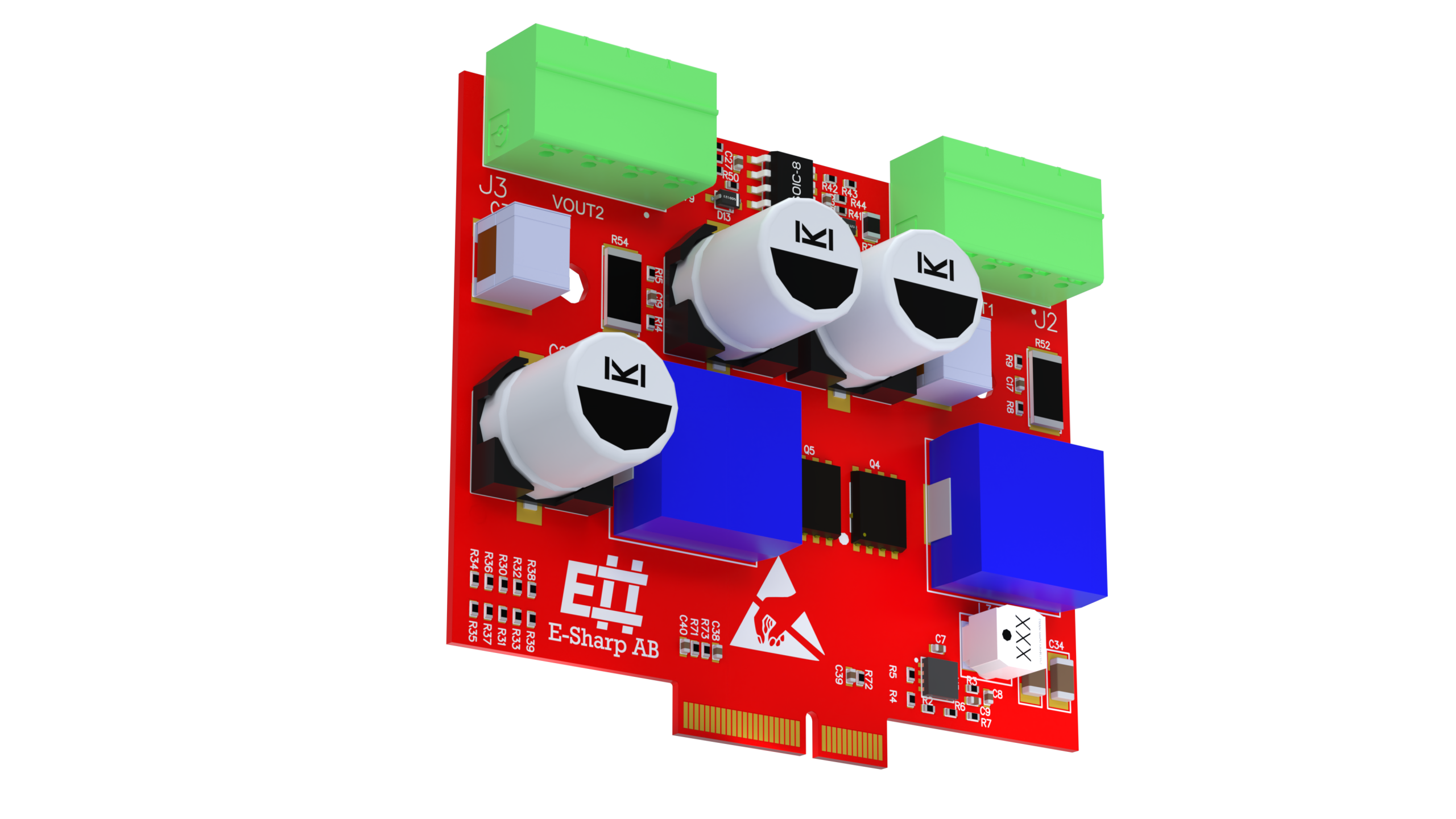
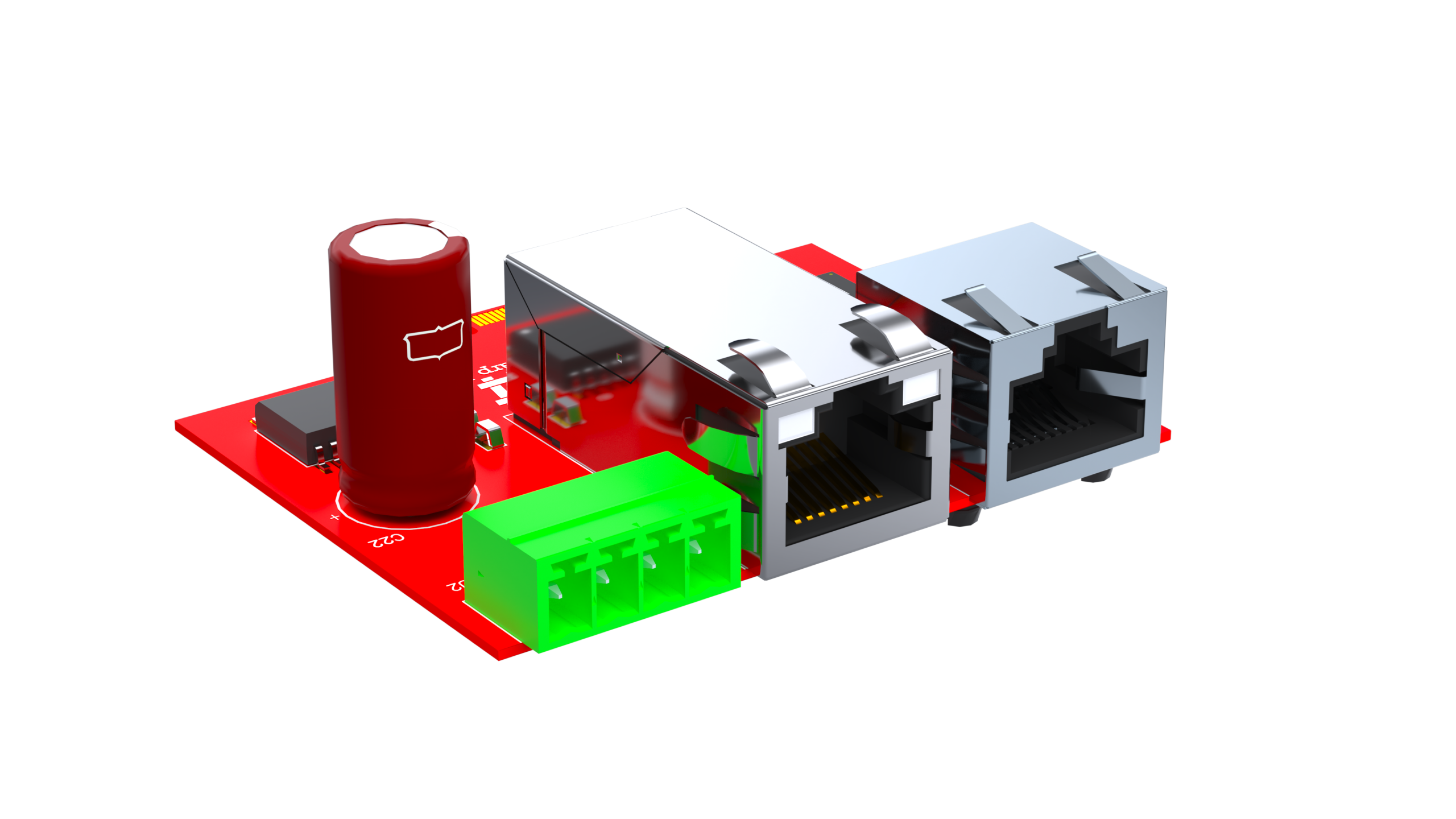
Mini-PSU
N-Top module for the Accordion test system — two buck-boost channels, 0–24 V at 1.5 A each, fully programmable over I²C.
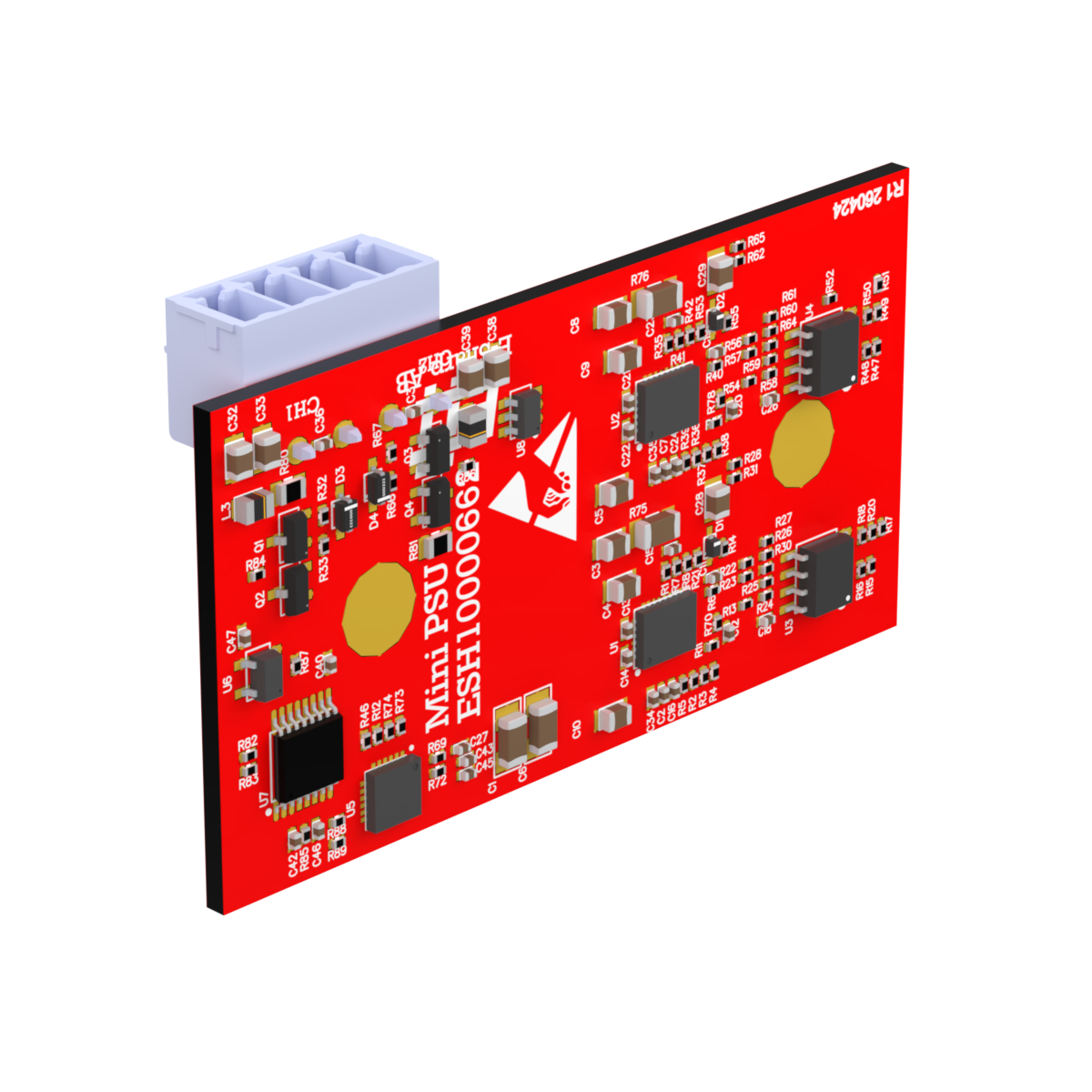


The Battery Simulator is a galvanically isolated, programmable power module that emulates battery behaviour in production and validation test. It delivers 0–10 V at up to 1 A as a bidirectional source/sink, with current limiting, on-board voltage and current measurement, and a hard isolation barrier between the host supply and the DUT-facing output. It plugs into Accordion test systems over the Expand Interface, so it can sit next to the DUT instead of in the chassis — and you don’t need to add isolation around it in the fixture.
The output stage is a programmable 0–10 V regulated rail with a configurable current limit up to 1 A. Constant-current mode engages automatically when the limit is reached, so the simulator behaves like a real battery driven into its own current limit rather than collapsing or fault-tripping. Bidirectional operation means the same channel can both source current into the DUT and sink current back from it — useful when testing devices that inject current into the battery node (charge circuits, regen paths, supercapacitor banks).
Eight programmable DAC/ADC channels (0–5 V) sit on the isolated side and break out on a 2×6 header, alongside 5 V and 12 V rails. They give you a place to drive an ID-pin, set a thermistor voltage to fake a battery temperature, or read a status signal — all on the DUT side of the isolation barrier, so the auxiliary signals stay galvanically separated from the host system the same way the main output does.
Output voltage, source current, and sink current are measured on board and read back over I²C, fast enough to use in a closed-loop control routine or a pass/fail check inside an automated test sequence. Overcurrent events trip an automatic shutdown; the host clears the fault and re-enables the output.
Trade-off to flag: at 0–10 V and 1 A the simulator covers single-cell and multi-cell Li-ion / NiMH packs and most handheld and IoT devices, but it is not built for high-current battery work. If you need tens of amps or higher voltages, this module is not the right tool.
The Battery Simulator connects to Accordion over the Expand Interface — a single M8 cable carrying input supply (VIN/GND) and a differential I²C Long Range link. That lets the simulator sit close to the DUT rather than bolted to the test chassis, which keeps the high-current battery wiring short and isolates the host system electrically.
Two things to know about the Expand Interface up front. First, I²C Long Range is a differential variant of I²C that embeds the clock in the data signal — it is not compatible with standard SDA/SCL, so you cannot drop a normal I²C device on this bus. Second, the Battery Simulator is fully software-controlled over that link: voltage, current limit, output enable, the eight auxiliary DAC/ADC channels, and all measurement read-back happen through the same I²C interface.
Full electrical specifications, the Expand Interface pinout, the J1 / J2 / J3 connector layouts, and the I²C control and measurement reference are maintained in the E-Sharp Help Center. See the Battery Simulator reference.
Full electrical specifications, the Expand Interface pinout, the J1 / J2 / J3 connector layouts, and the I²C control and measurement reference are maintained in the E-Sharp Help Center. See the Battery Simulator reference.