Product design
Product design, backed by our own engineering toolchain
We design electronics, embedded software, FPGA and mechanics as complete, production-ready products — and we build the tools we design with: Trace for specification, Probe for design review, Maestro for test. Our own toolchain, used on every project, means fewer iterations and a more predictable path from idea to hardware you can trust.
Our own tools for spec, design review & test • 50+ years combined engineering experience
What we design
One team, the whole product
Most products need more than one discipline to work. We keep electronics, embedded software, FPGA and mechanics in one team, so the interfaces between them are designed — not discovered late. Need only part of it? That’s fine — you just don’t have to coordinate several suppliers to get a product that fits together.
Electronic design
Schematic design and PCB layout for production — from analog front-ends to high-speed digital. We capture the specification with Trace, then review the design, schematic and BOM against it with Probe, so problems surface on screen and not on the bench.
Embedded software
Firmware, drivers and application code for the products we design — bare-metal to RTOS, matched to the MCU and the hardware around it, and written so it can be tested and maintained.
FPGA design
Programmable logic where it counts — VHDL for Xilinx/AMD FPGAs. High-throughput data paths, signal processing and control, matched to the electronics we design around them.
Mechanical design
Enclosures, brackets and fixturing designed around the electronics — fit, tolerances, thermal path and assembly. We do mechanical design as part of a product, not on its own, so it stays tied to how the product actually works.
Why fewer iterations
We build our own tools
Most design houses use the same off-the-shelf tools as everyone else. We build our own, and use them on every project. Trace turns your requirements into a structured specification. Probe reviews the design, schematic and BOM against that spec and shows where they won’t deliver — before anything is built. Maestro authors the test sequences that prove the finished hardware. Each stage hands evidence to the next.
The result is fewer design iterations and less back-and-forth — a shorter, more predictable path from idea to a product you can trust. That’s where most of the cost and delay in hardware development actually sits, and it’s what our toolchain is built to remove.
Cross-disciplinary, under one roof
The interfaces are designed, not discovered
The hard problems in hardware usually live between disciplines — the connector that doesn’t fit the enclosure, the FPGA I/O that the layout can’t route, the thermal path no one owned. With electronics, mechanics, FPGA and firmware in the same team, those interfaces are a design decision, not a surprise at integration.
You get one point of ownership for architecture, BOM and delivery — and manufacturable design files at the end, not a pile of parts that each work alone.
Prototype fast, in-house
From concept to a verified board in days
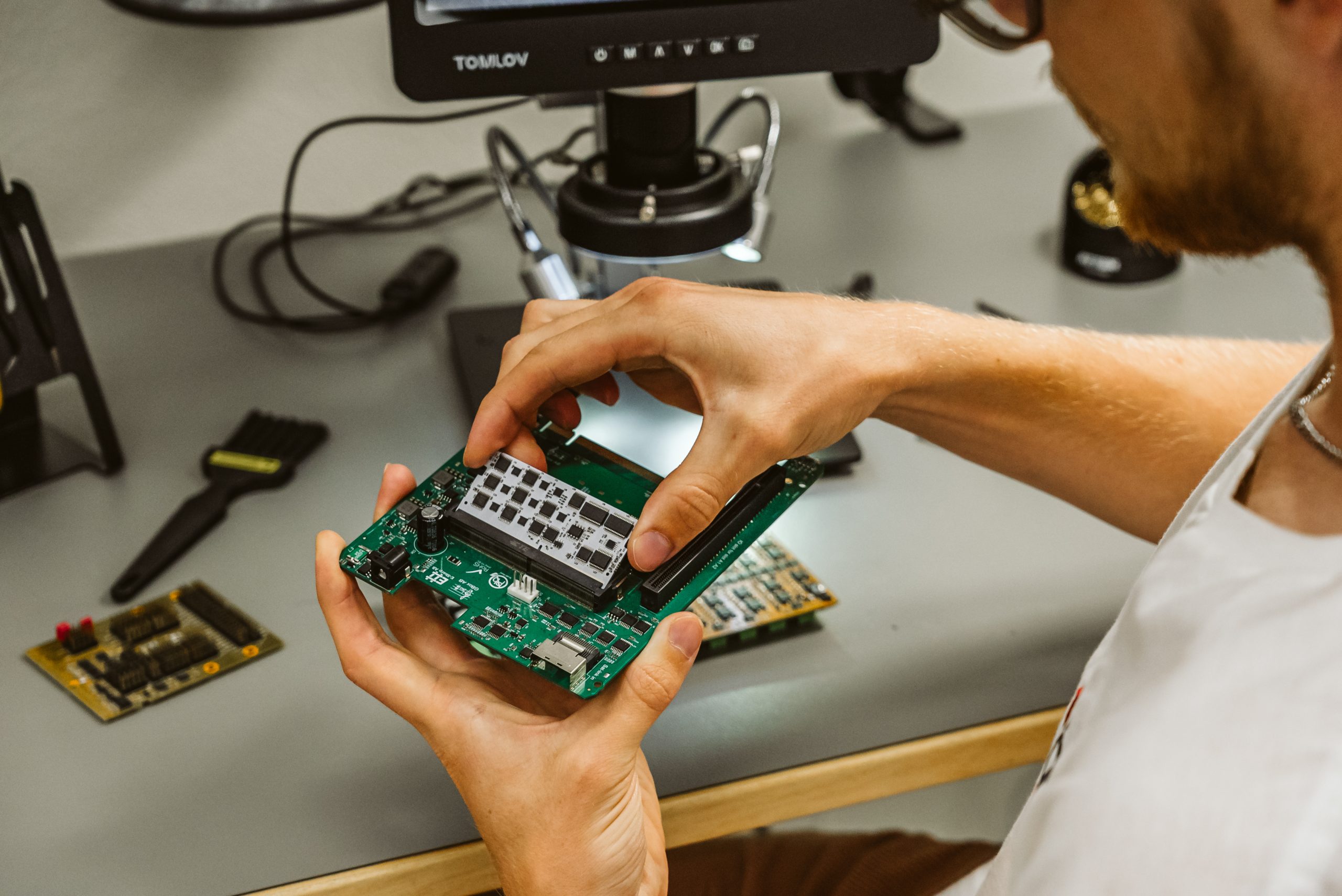
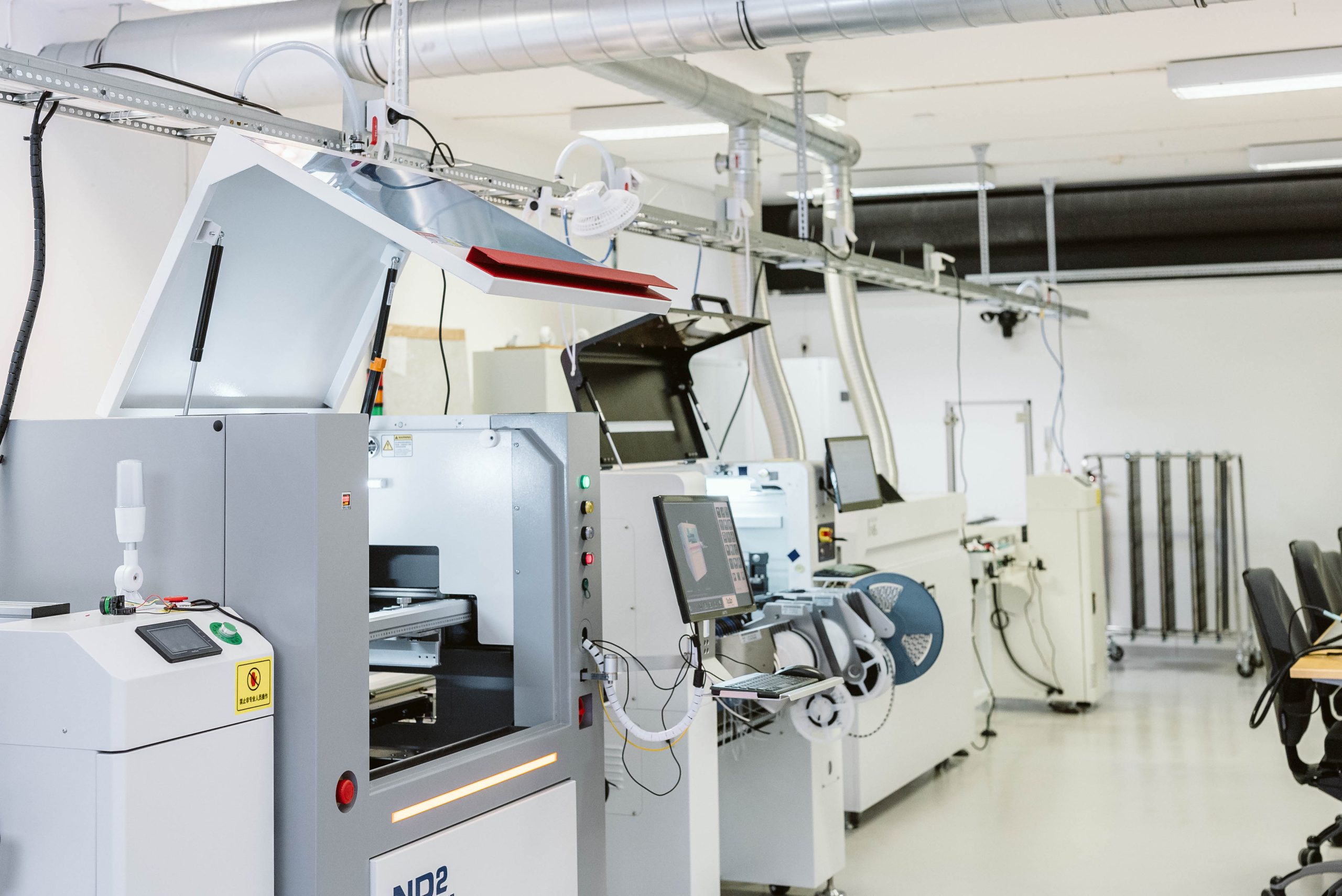
We keep design, assembly and verification in the same building, on our own SMT line — so there are no supplier handoffs between drawing a board and holding a working one. That compresses iteration to days and lets us catch problems early, when a fix is a layout change and not a production stop.
The same workshop — soldering, assembly, a temperature chamber and custom rigs — carries the product into design verification without leaving the room.
How we work
From architecture to a product ready for production
A clear path, with you involved at every gate — no black-box design, no surprises at the end.
Architecture & spec
We agree the requirements, interfaces and BOM direction — and where the real risks are.
Design
Electronics, mechanics and FPGA/firmware designed together, for testability and manufacturing.
Prototype & bring-up
Built and brought up in-house on our SMT line — fast iterations on real hardware.
Verify
Validated against the spec under real-world conditions — test sequences authored in Maestro — before it goes near volume.
Production handoff
Manufacturable files, documentation — and, if you need it, the test system to ramp it.
What you get
Manufacturable, documented, and yours
Scope is agreed up front and set in the quote. A typical product-design engagement delivers, for example:
- Schematics & PCB layout
- Mechanical CAD & enclosure
- FPGA/VHDL & firmware
- BOM selection & sourcing support
- DFT & DFM review
- Manufacturable production files
- Design & interface documentation
- Verified prototypes
- Specification & architecture
Selected work
Products we’ve helped build
From complex, high-reliability systems to focused single-board products.
When this fits
Honest scoping
A good fit when you…
- Need a product designed across disciplines — electronics, embedded, FPGA and mechanics — not just one of them in isolation.
- Want to reach a solid, verified design in fewer iterations, with a proven in-house toolchain doing the heavy lifting.
- Are building industrial electronics, datacenter/AI hardware, IoT, or other complex, higher-reliability products.
- Value one point of ownership over architecture, BOM and delivery instead of coordinating several suppliers.
Not the right partner if you…
- Only need mechanical CAD as a standalone service — we design mechanics as part of a product.
- Are looking for a volume PCBA or contract manufacturer.
- Have a simple board with no real complexity that a generic design shop can turn around.
- Want the cheapest possible layout with no design depth behind it.
Frequently asked
Questions we get early
Can you take on just part of the design?
Yes — plenty of projects are electronics-only, or embedded/FPGA work for a board you’ve already designed. The one thing we don’t offer standalone is mechanical design; we do that as part of a product so it stays tied to how the electronics and the enclosure actually work together.
What are Trace, Probe and Maestro?
They’re our own engineering tools, used on every project. Trace turns requirements into a structured specification; Probe reviews the design, schematic and BOM against that spec; Maestro authors the test sequences that verify the finished hardware. Together they cut the number of iterations it takes to reach a design you can trust.
Do you manufacture at volume?
No. We design products and build and verify prototypes in-house, then hand off manufacturable files — and, if you want it, the test system to ramp production. For volume build we work alongside your contract manufacturer rather than replacing them.
Can you start from a half-finished design?
Often, yes. We can pick up a partial schematic, a rough spec or a first prototype and take it forward. Bringing us in early usually shortens the path to production — the main trade-off to know is that late architecture changes can mean rework, which adds cost and lead time.
What does it cost?
Every project is scoped and quoted, so we don’t publish fixed prices. Cost is driven by complexity, the number of disciplines involved, and how much verification the product needs. The fastest way to a number is to tell us about your product and ask for a quote.
Get started
Tell us what you’re building
Book a 30-minute call or send us a message first. We’ll tell you honestly whether it’s a fit and what a sensible first step looks like.