A model TestStand users already recognise — annual developer and runtime licenses — with one difference that matters: your tests are stored in open, readable YAML in Git and stay yours. You license the engine, not your own work.
Maestro launches later in 2026. Pricing is published here so you can plan; register to be told when you can buy.
Request early accessHow Maestro is licensed
Maestro is a proprietary product with two annual license types — one for the engineers who author tests, one for the stations that run them. Both are subscriptions that renew yearly, so updates and security patches are always included while your subscription is active.
Three principles shape the model:
- Self-hosted, you own your data. You run the hosting and the PostgreSQL database. E-Sharp measures no usage and holds none of your data.
- Open formats, licensed engine. Test definitions are readable YAML in your own Git repository. The format is open; only the engine that runs them is licensed. Your tests are never locked in.
- No per-seat lock-in on runtime. Runtime licenses are floating — buy concurrent capacity, not named machines — so you can move capacity across stations as your line changes.
Developer license — for the engineers who author tests
Annual, per named author. Includes the authoring IDE and AI-assisted test development, with all updates included on renewal. This is the seat an engineer uses to turn intent into tests.
Price (EUR per seat / year):
- 1–4 seats — €2,000 per seat
- 5–14 seats — €1,550 per seat
- 15+ seats — €1,100 per seat
The whole quantity is priced at the tier it falls into.
Runtime license — for the stations that run tests
Annual and floating (concurrent): one license equals one concurrent node, no matter how many parallel executions that node runs. You buy a pool of concurrent runtimes and apply them across different stations week to week — you’re buying capacity, not individual machines. Concurrency is handled by a self-hosted license server that you run.
Price (EUR per license / year):
- 1–9 licenses — €500 each
- 10–49 licenses — €400 each
- 50+ licenses — €300 each
Maintenance is included
There’s no separate maintenance fee. Because every license is an annual subscription, an active license already includes new versions, compatibility and security patches, bug fixes and hotfixes. When a subscription lapses, updates and support stop — the model is deliberately simple.
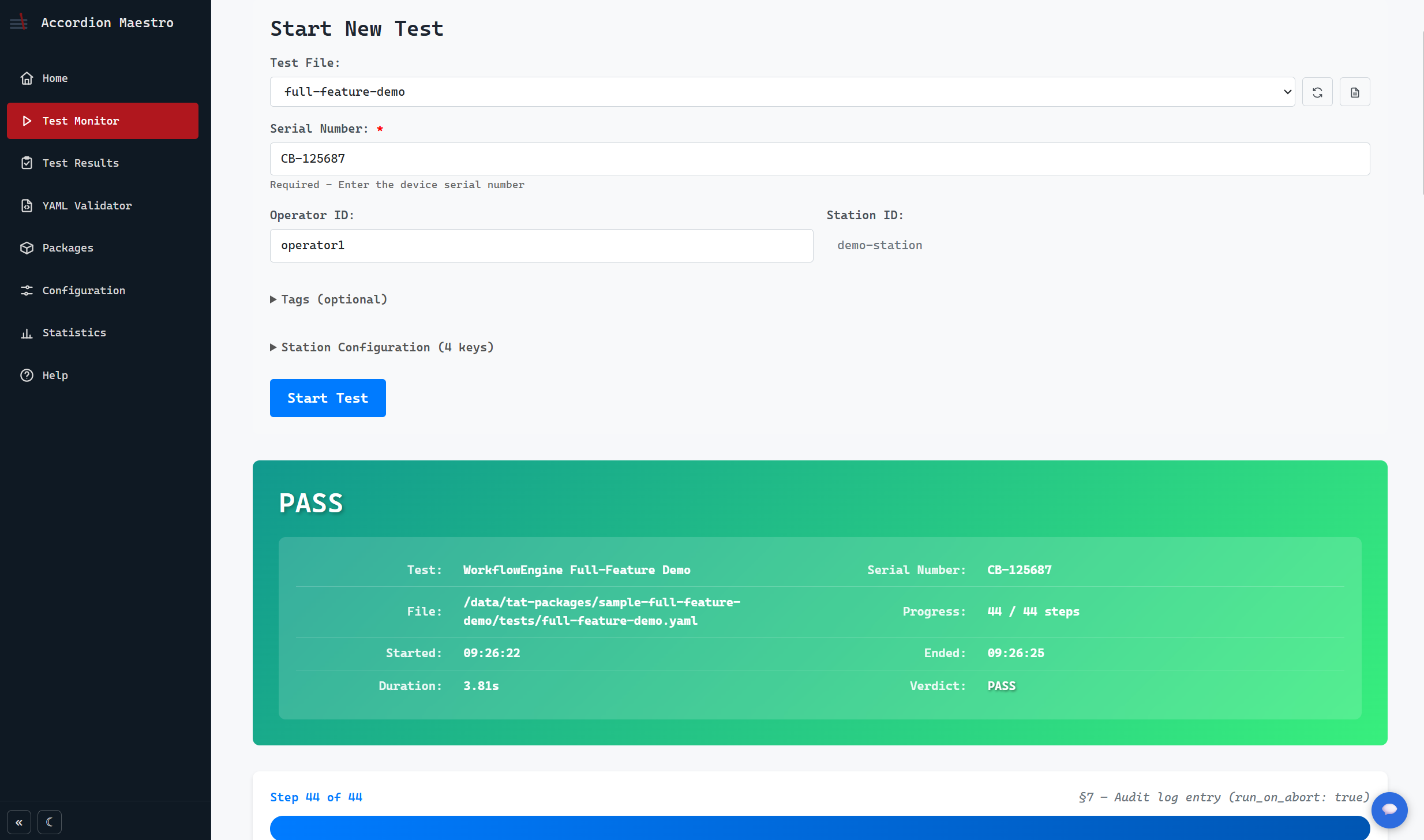
Try the live demo
Run Maestro yourself before you commit. The demo is open for evaluation — no license, no signup, no obligation. The fastest way to judge whether the model fits your bench.
See the full Maestro story
Intent-based authoring, queryable results, self-hosted, cross-platform — the complete picture of what Maestro does and where it fits. Start here if you landed on pricing first.
FAQ
Is there a free or open-source version? No. Maestro is a proprietary product. The free surface is the live demo, open for evaluation with no license required.
Do you host Maestro for us? No — Maestro is self-hosted by design. You run the hosting and the PostgreSQL database, which means you own and control your test data end to end.
What’s the difference between a developer and a runtime license? A developer license is per named engineer who authors tests. A runtime license is floating capacity for the stations that run tests — one license per concurrent node.
Are my tests locked into Maestro? No. Test definitions are open, readable YAML in your own Git repository. Only the engine that runs them is licensed.
Is maintenance extra? No. Updates, patches and fixes are included while your subscription is active.
Can I change how many runtime licenses I have? Yes — runtime is floating, so you size the concurrent pool to your needs and move that capacity across stations.
When can I buy? Maestro launches later in 2026. Register your interest and we’ll contact you the moment it’s available to acquire.