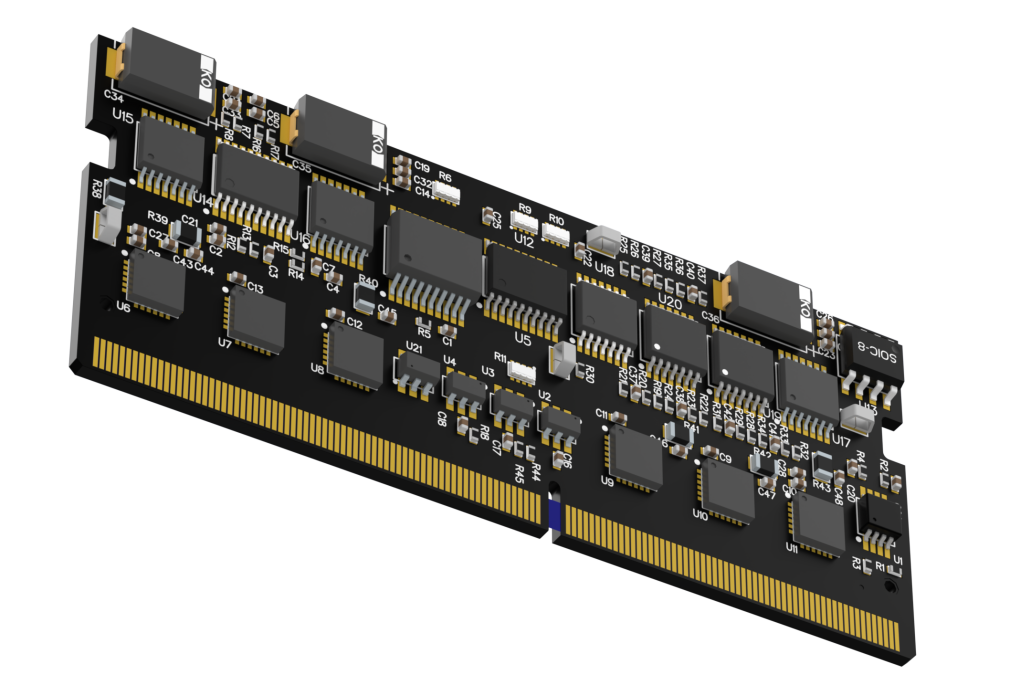
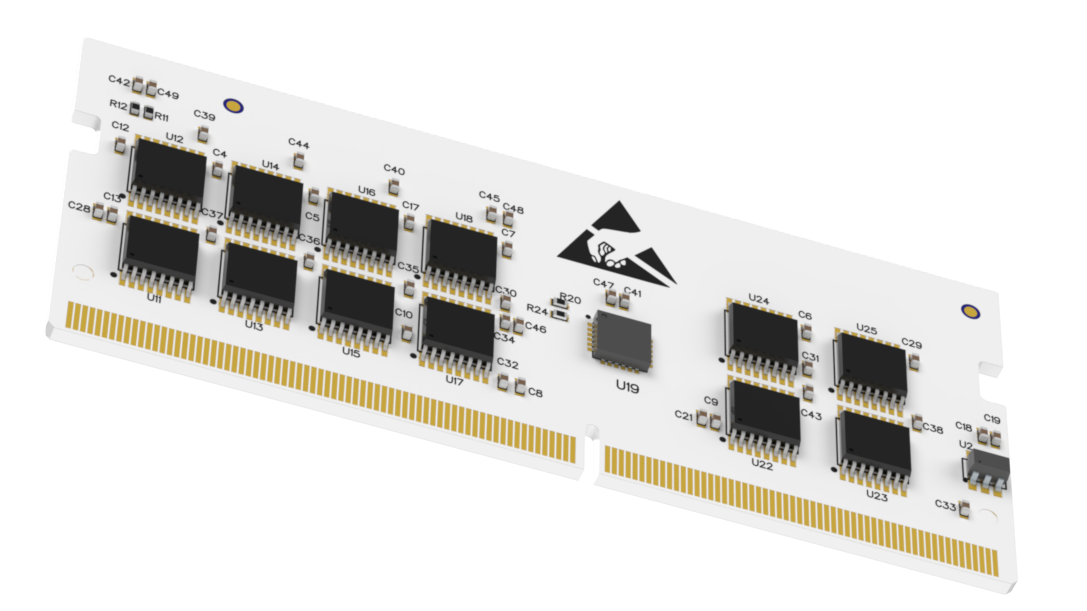
Tone Audio Module
A line-level audio source and analyzer in SO-DIMM form. Two DAC outputs, four ADC inputs, 96 kSps / 24-bit, all DSP on-module.
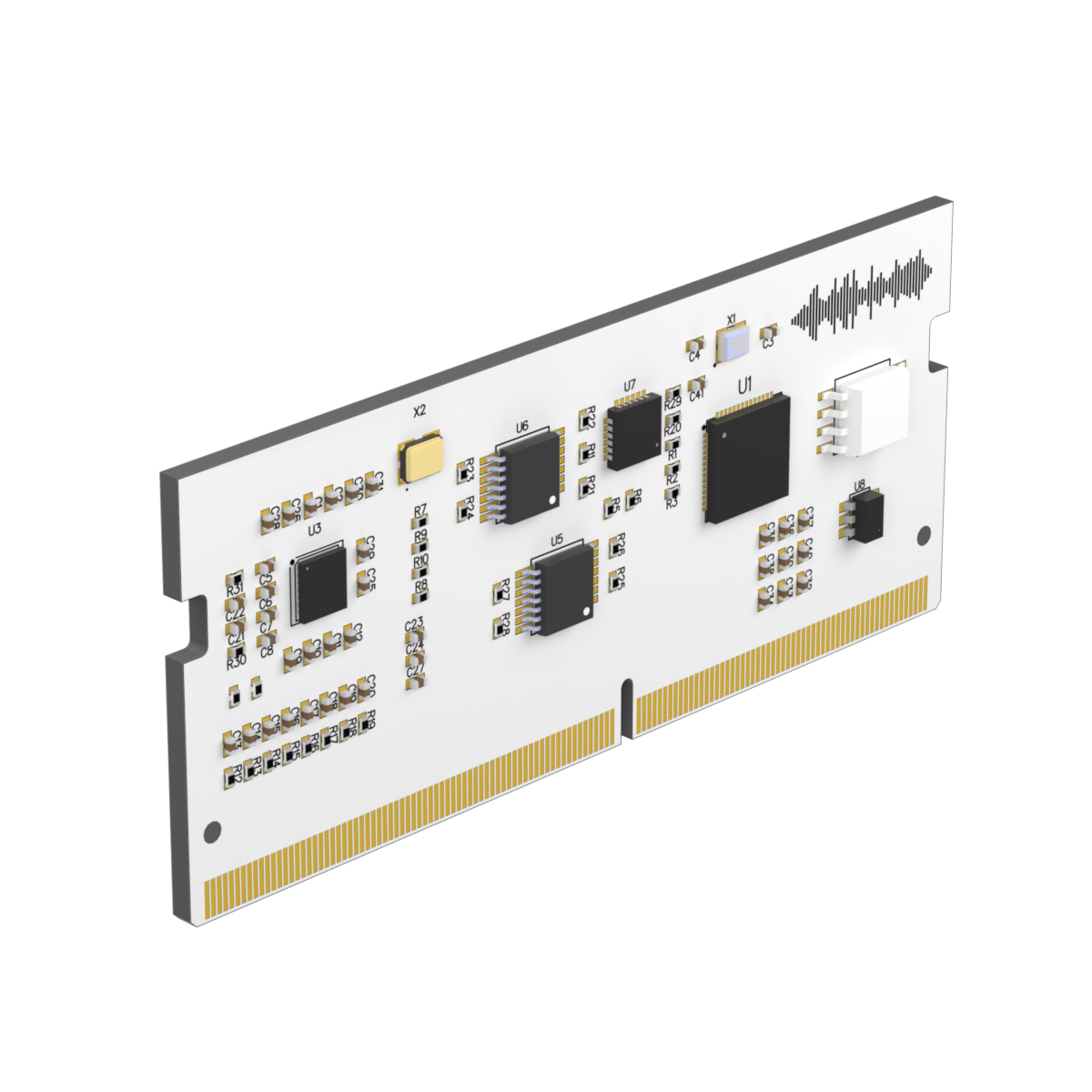


The Precision ADC/DAC Module is a high-resolution analog I/O card for Accordion test systems, combining twelve 24-bit ADC channels and eight 16-bit DAC channels in a single slot. It is built for the points in a test sequence where accuracy matters more than channel count — voltage measurements that must hold their absolute calibration, stimulus that has to be quiet and stable, and biasing that needs to land on the millivolt. The module is integrated as a standard Accordion module and is fully software-controlled.
The ADC side runs on the ADS124S08, giving 24-bit resolution across twelve single-ended channels with a configurable ±2.625 V bipolar or 0–AVDD unipolar range. The DAC side uses the AD5675R — an 8-channel 16-bit converter referenced to an internal 2.5 V reference, with output spans of 0–2.5 V (gain = 1) or 0–5 V (gain = 2). Calibration gain and offset are stored on the module per channel and applied automatically in hardware, so a module that has been calibrated keeps its calibration when moved between Accordion frames.
For higher-rate work, ADC channels can be put in numeric result mode: configurable sample count and rate, multi-channel synchronized capture, and optional on-module data reduction (min, max, average, standard deviation). Results come back as a Base64 payload through the standard channel API, which keeps the wire format compact for long captures.
ADC and DAC channels can also operate as pseudo-digital I/O — define VL and VH thresholds and the channel reports logic state with built-in hysteresis (values between VL and VH retain the previous state). On a DAC channel, the output is driven to VH or VL for logic HIGH/LOW. Useful for occasional logic-level interfacing without dedicating a separate digital module.
Trade-off to flag: at up to 4 kSPS per ADC, this is precision-class measurement, not waveform capture. For higher channel counts of pseudo-digital I/O or faster sampling, pair this module with the MPIO-96 SPI Module.
Channels are exposed through the standard Accordion naming scheme: {ModuleIndex}.ESH10000590.{ChannelName}, where ChannelName is one of ADC00–ADC11, DAC00–DAC07, or CALIBRATION. ADC channel 5 on a module at slot 0 is referenced in software as 0.ESH10000590.ADC05 — the same syntax used across every Accordion module.
The CALIBRATION channel exposes the full calibration table for read and write as Base64, keyed against the module’s product ID, revision, and serial number. Calibration data persists across resets and is applied automatically at boot. Misconfiguration — unknown channel name, wrong direction, VH below VL, output to a disabled channel — returns an explicit error rather than silent undefined behaviour.
Full electrical specifications, accuracy and INL/DNL references, the complete channel-naming and configuration reference, pseudo-digital threshold rules, calibration handling, and the pinout mapping to the internal converter devices are maintained in the E-Sharp Help Center. See the Precision ADC/DAC Module reference.
Full electrical specifications, accuracy and INL/DNL references, the complete channel-naming and configuration reference, pseudo-digital threshold rules, calibration handling, and the pinout mapping to the internal converter devices are maintained in the E-Sharp Help Center. See the Precision ADC/DAC Module reference.