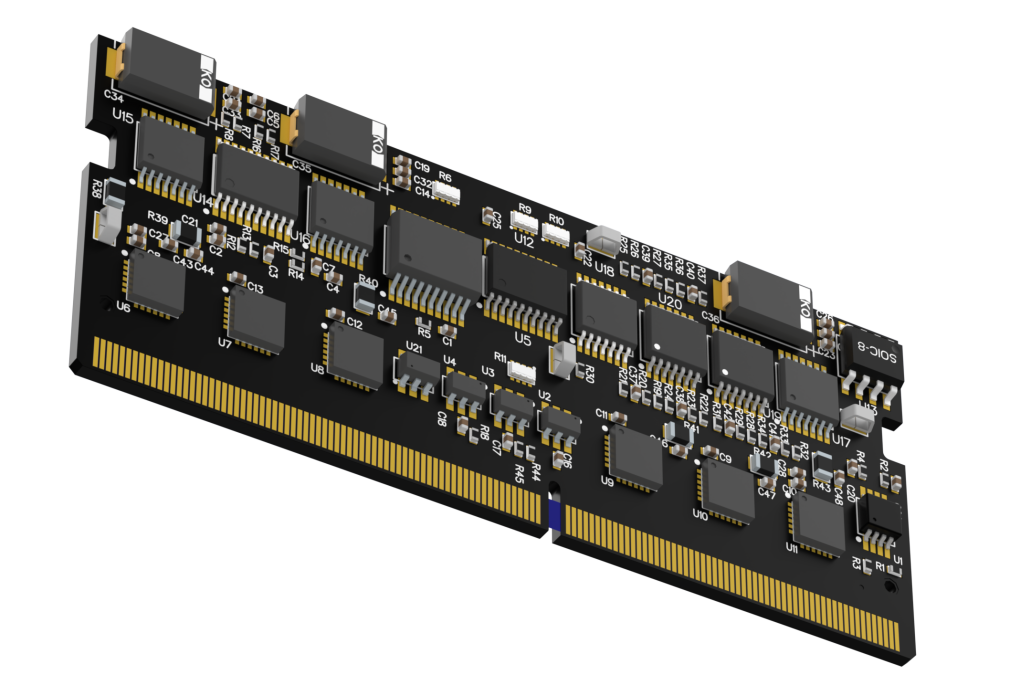
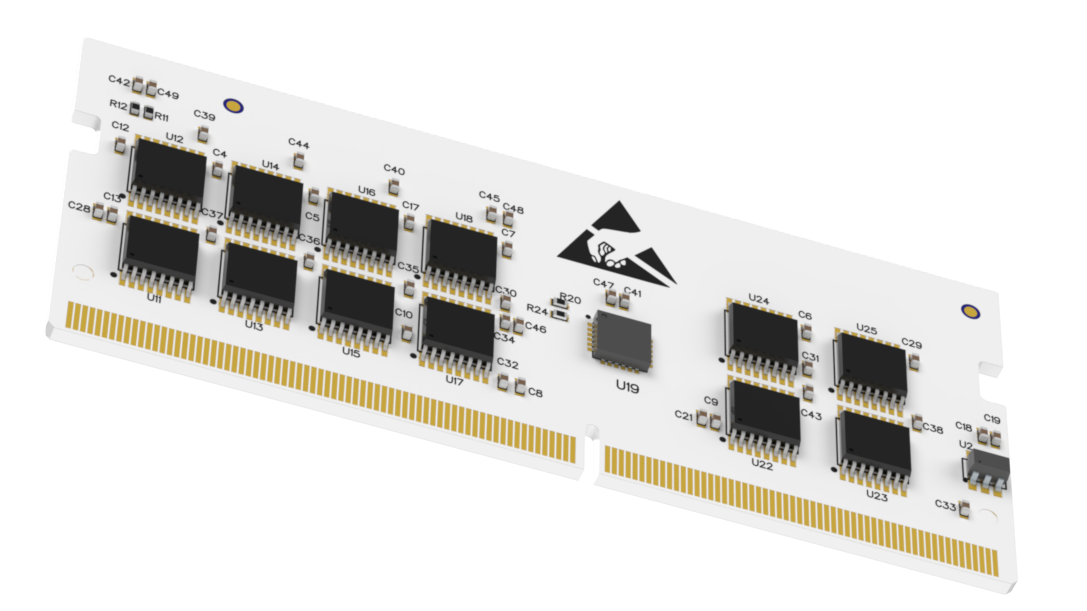
Precision ADC/DAC Module
Precision analog I/O for Accordion: 12 × 24-bit ADC and 8 × 16-bit DAC channels, calibrated per channel and stored on the module.

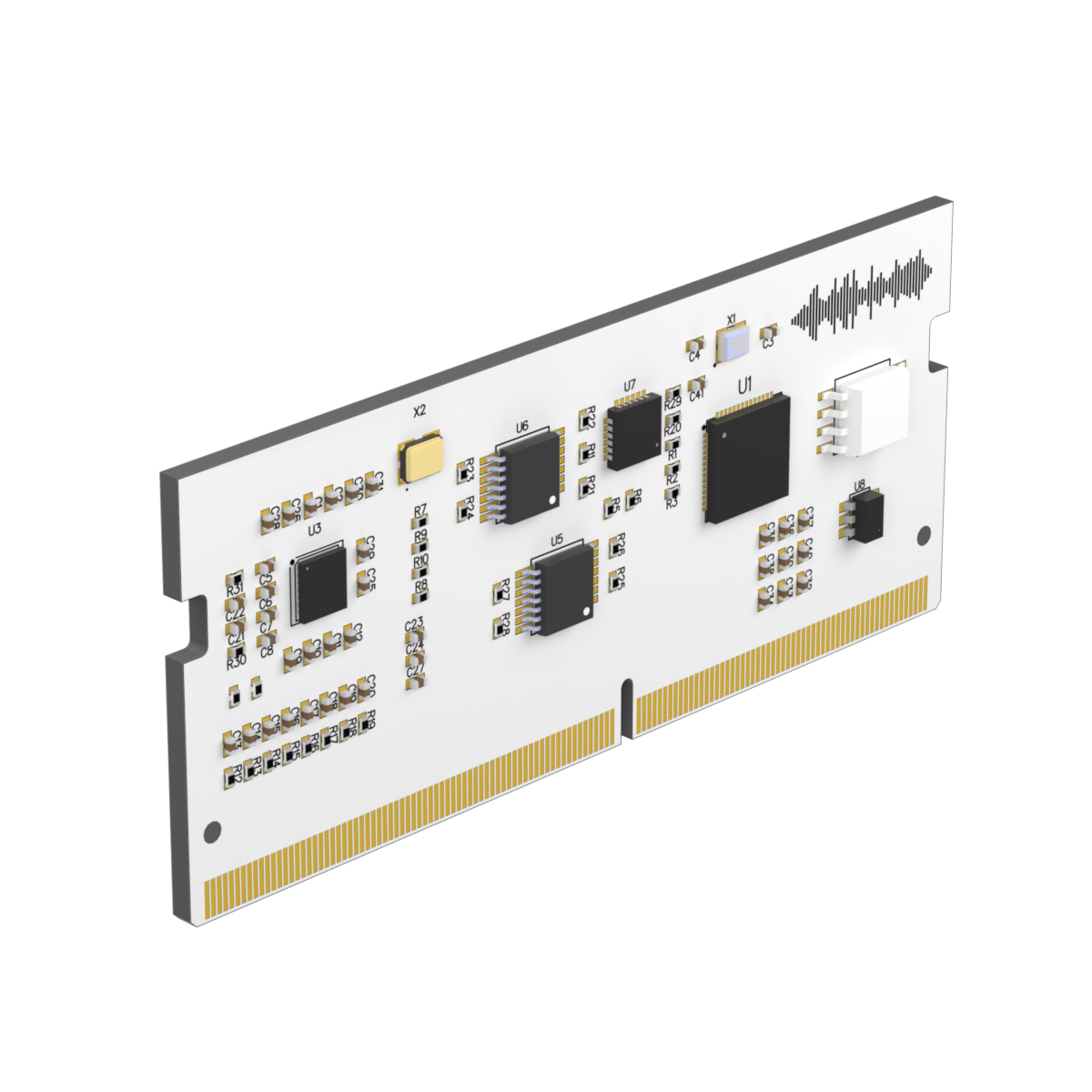
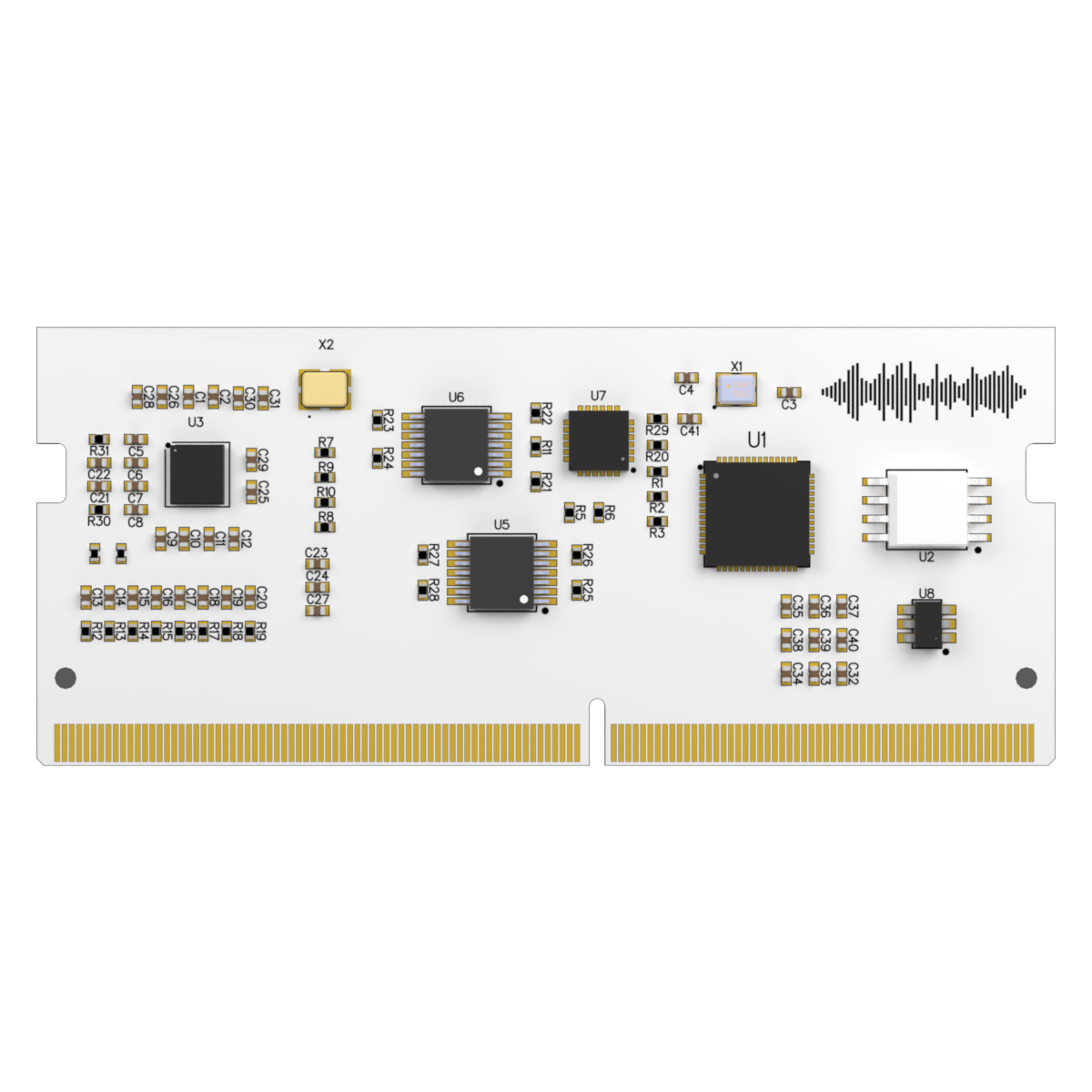
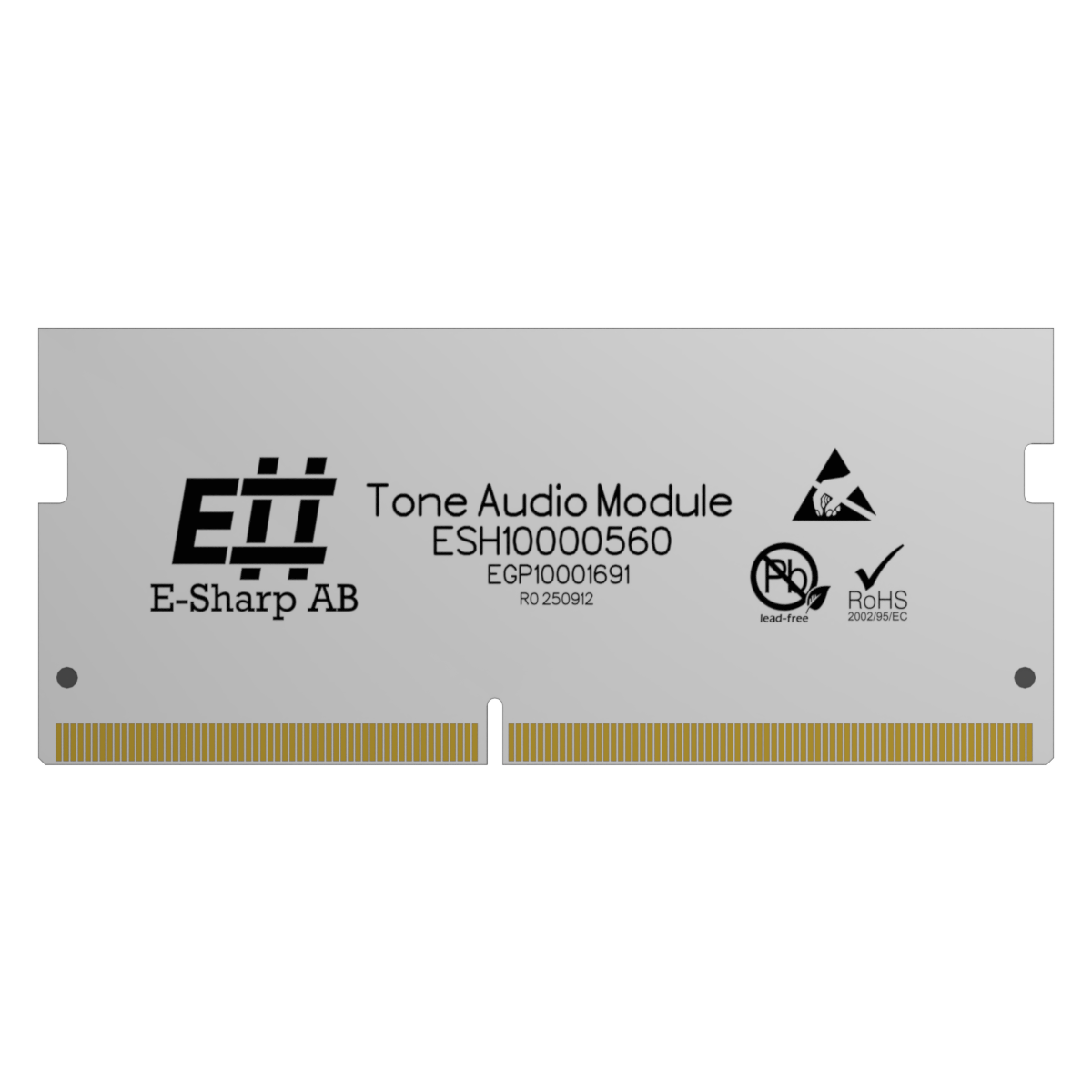
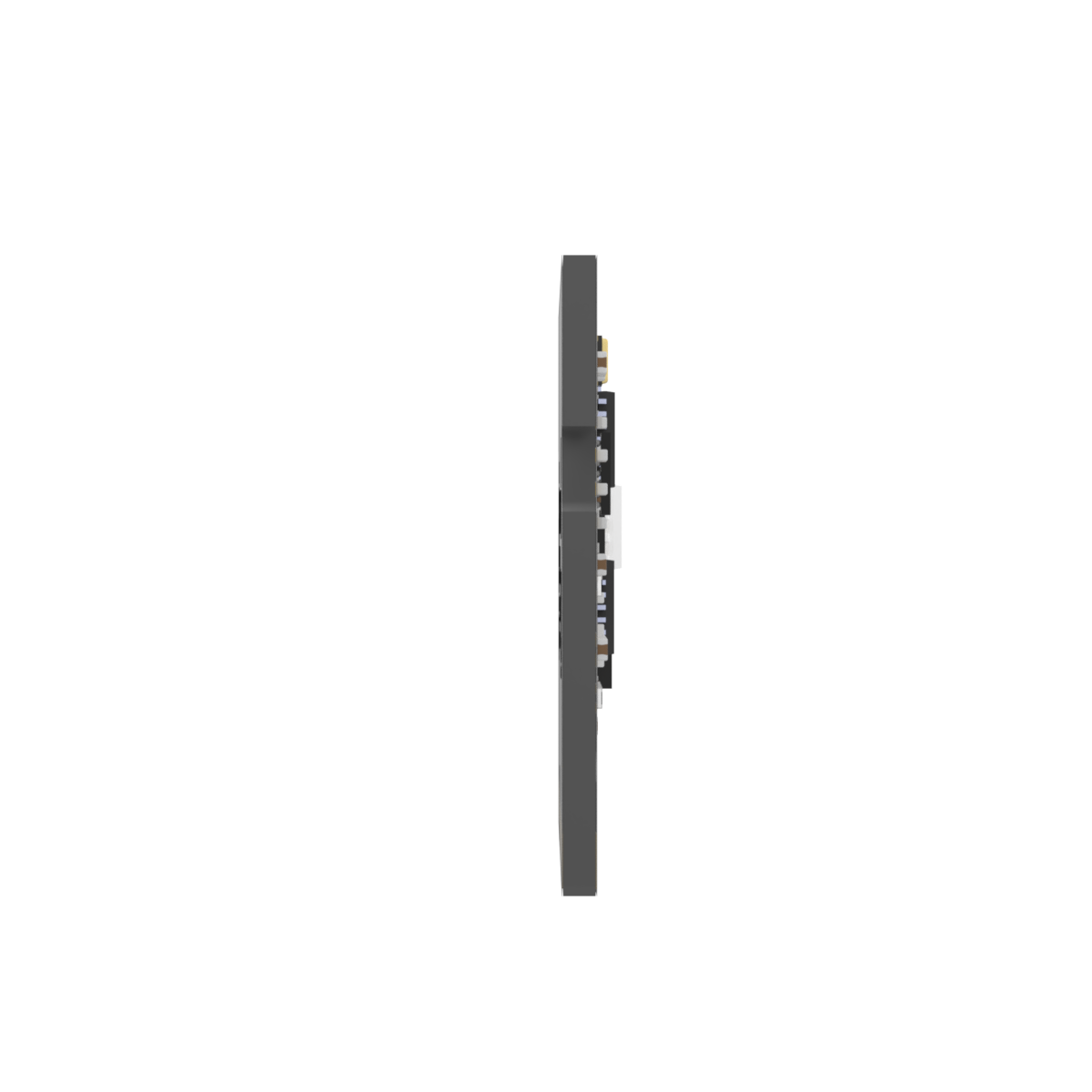

The Tone Audio Module is a line-level audio source and analyzer that plugs into the Accordion test platform as an SO-DIMM module. It generates test tones on two DAC channels and measures frequency, RMS, peak-to-peak, THD, and SNR on four switched ADC inputs — all locally, with only commands and scalar results crossing the backplane. Audio test steps stay deterministic without consuming Accordion’s data path.
Audio generation runs continuously once configured. Set the waveform, frequency, and per-channel gain on either DAC; the module produces the tone without further sample streaming from the host. The two output channels are independent.
Measurement runs on the four multiplexed ADC inputs, organized as 4 × 2 with programmable input gain. Sampling, DSP, and metric extraction execute on the module, so the host receives processed scalars — frequency, Vrms, Vpp, THD, SNR — rather than raw sample streams. Test step time stays predictable, and 96 kSps × 24-bit data never has to cross the Accordion backplane.
Trade-offs are explicit. All external interfaces are line level; the internal I²S and DSP paths are not exposed externally. Sample rate and bit depth are fixed in hardware. Applications that need speaker-level drive or raw sample capture sit outside this module’s scope.
The module operates as a server in a client–server pattern over UART: Accordion issues configuration, control, and result-retrieval commands; the module exposes audio generation and measurement as high-level operations. Raw audio never leaves the module, so backplane usage stays minimal regardless of how often a test sequence calls into it.
Six GPIO pins are available for peripheral control around the audio path — switching loads, muting paths, asserting test points — under the same UART control surface, so a complete audio test step can be expressed without reaching outside the module.
The full datasheet — electrical specs, the UART command protocol, GPIO assignments, supported measurement modes, and the connector pinout — lives in the E-Sharp help center. See ESH10000560 – Tone Audio Module for the complete reference.
The full datasheet — electrical specs, the UART command protocol, GPIO assignments, supported measurement modes, and the connector pinout — lives in the E-Sharp help center. See ESH10000560 – Tone Audio Module for the complete reference.