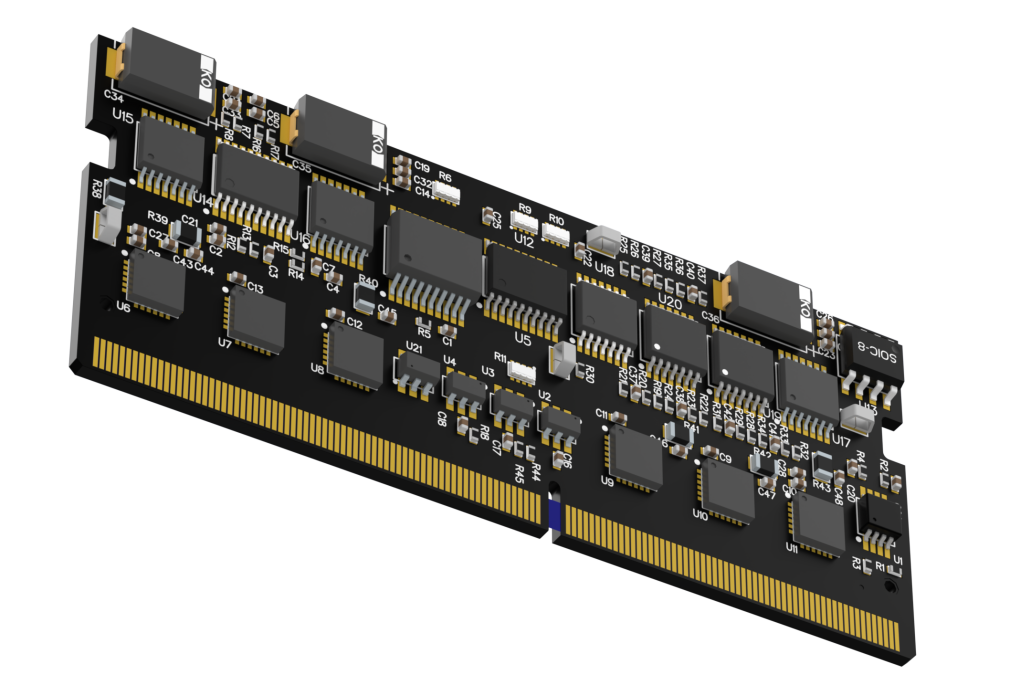
Tone Audio Module
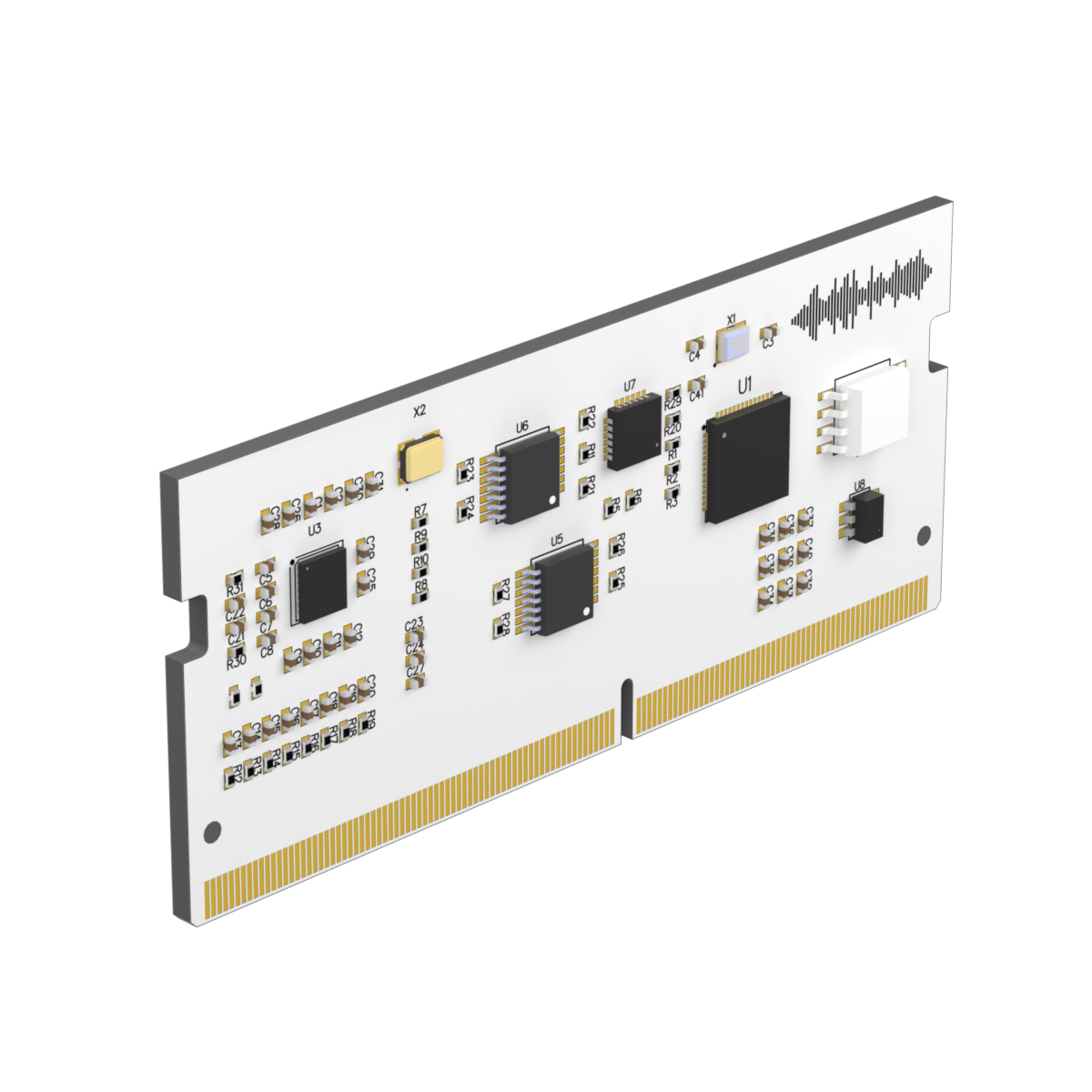
A line-level audio source and analyzer in SO-DIMM form. Two DAC outputs, four ADC inputs, 96 kSps / 24-bit, all DSP on-module.
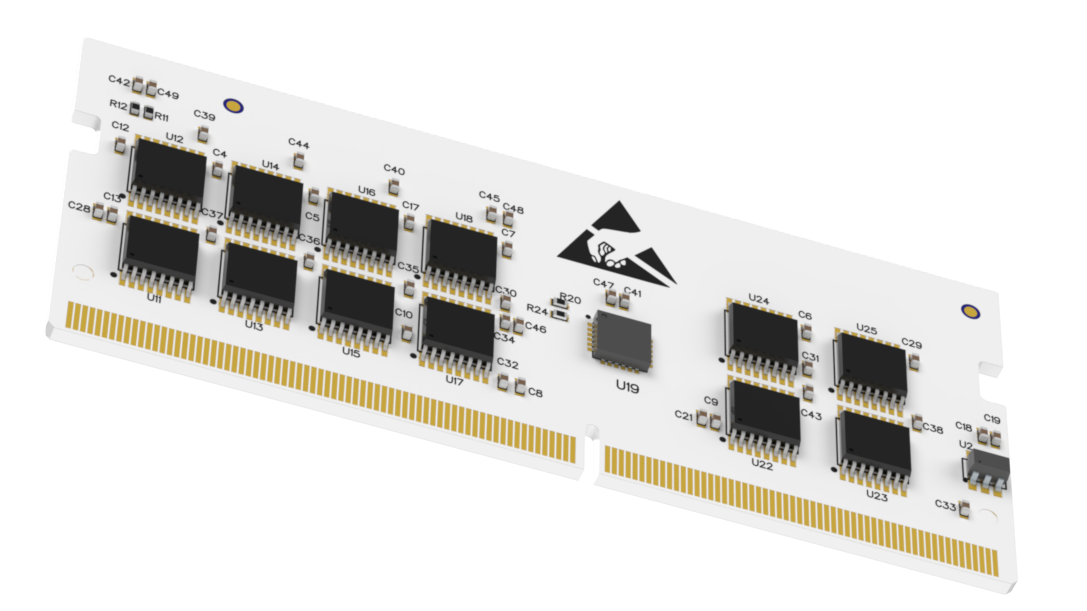
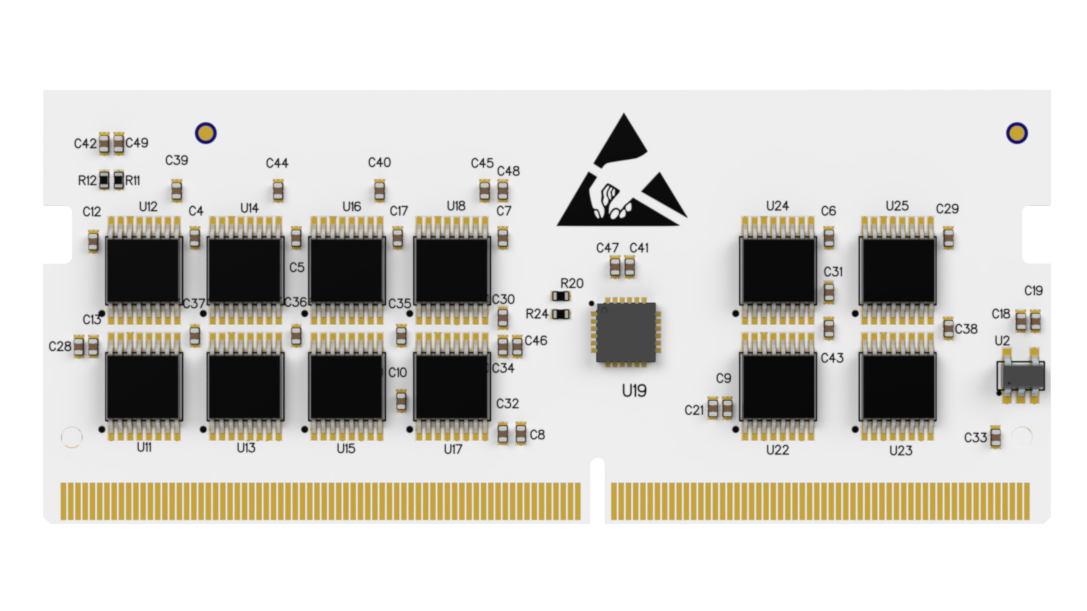

The MPIO-96 SPI Module is a high-density I/O card for Accordion test systems, providing 96 bidirectional channels in a single slot. Every channel can act as an analog input, analog output, or pseudo-digital I/O — and the role can change at runtime. It is built for PCBA test fixtures and production test setups where channel direction and behaviour vary across the test sequence.
Each group of eight channels is backed by an Analog Devices AD5592R, giving 12-bit ADC and 12-bit DAC capability across all 96 channels. The differentiator is the pseudo-digital mode: set VH below 0 V and a channel emulates open-drain — logical HIGH switches the channel to a high-impedance input, logical LOW drives VL. Set VL below 0 V and the channel emulates a floating output. A single MPIO channel can therefore share a node with external pull-ups or mixed-signal logic without extra discretes on the fixture.
Channels default to INPUT and direction must be configured explicitly before use — a deliberate choice that keeps the module from driving a powered DUT by accident. When a channel is configured as pseudo-digital output, direction can flip at runtime, which is how the open-drain and floating modes work. Batch configuration of a full group of 8 in one SPI transaction is faster than configuring channels individually and is the recommended pattern for fixtures with many active nets.
Trade-off to flag up front: at 12-bit resolution and a 0–5 V range, this module is built for density and flexibility, not for precision instrumentation. For sub-millivolt work or 16-bit acquisition, use the Precision ADC/DAC Module.
The module plugs into any Accordion slot and exposes its channels through the standard Accordion naming convention: {ModuleIndex}.ESH10000568.MPIO{00–95}. Channel 42 on a module at slot 1 is referenced in software as 1.ESH10000568.MPIO42 — the same scheme used for every other module, so a fixture script reads consistently regardless of the mix installed.
A NumericResult channel is exposed for synchronized multi-channel acquisition with configurable sample rate and optional data reduction, delivered through the same channel API used elsewhere in Accordion. Calibration data is stored on the module itself and applied automatically, so a module can move between Accordion frames without re-calibrating the receiving system.
NumericResultFull electrical specifications, the complete channel-naming and configuration reference, pseudo-digital mode tables, calibration procedure, and the pinout mapping to the internal AD5592R devices are maintained in the E-Sharp Help Center. See the MPIO-96 SPI Module reference.
Full electrical specifications, the complete channel-naming and configuration reference, pseudo-digital mode tables, calibration procedure, and the pinout mapping to the internal AD5592R devices are maintained in the E-Sharp Help Center. See the MPIO-96 SPI Module reference.